English Article
Why business electricity bills stay high even when usage is not extreme: Demand Charge, Peak Load, and how Solar + Smart Energy Management help
A practical English version of our Thai article for business owners, facility teams, fleet operators, EV charging sites, and organizations evaluating solar, energy monitoring, or load management investments.
Published: 2026-07-03
At a glance
Why this topic matters
Many businesses try to reduce electricity cost by looking only at monthly kWh usage. That often misses a critical part of the bill: Demand Charge, which is based on the highest power demand reached during the billing cycle. If several high-load devices run at the same time, the bill can stay high even when total energy consumption does not look extreme.
Key numbers
Sample bill used in the article
Monthly Bill
THB 51,325
Total bill in the example site.
Energy Use
10,480 kWh
Total monthly electricity consumption.
Peak Demand
66.10 kW
Maximum simultaneous power draw.
Demand Charge
THB 12,972.79
About 25% of the total bill.
Cover
Article visual
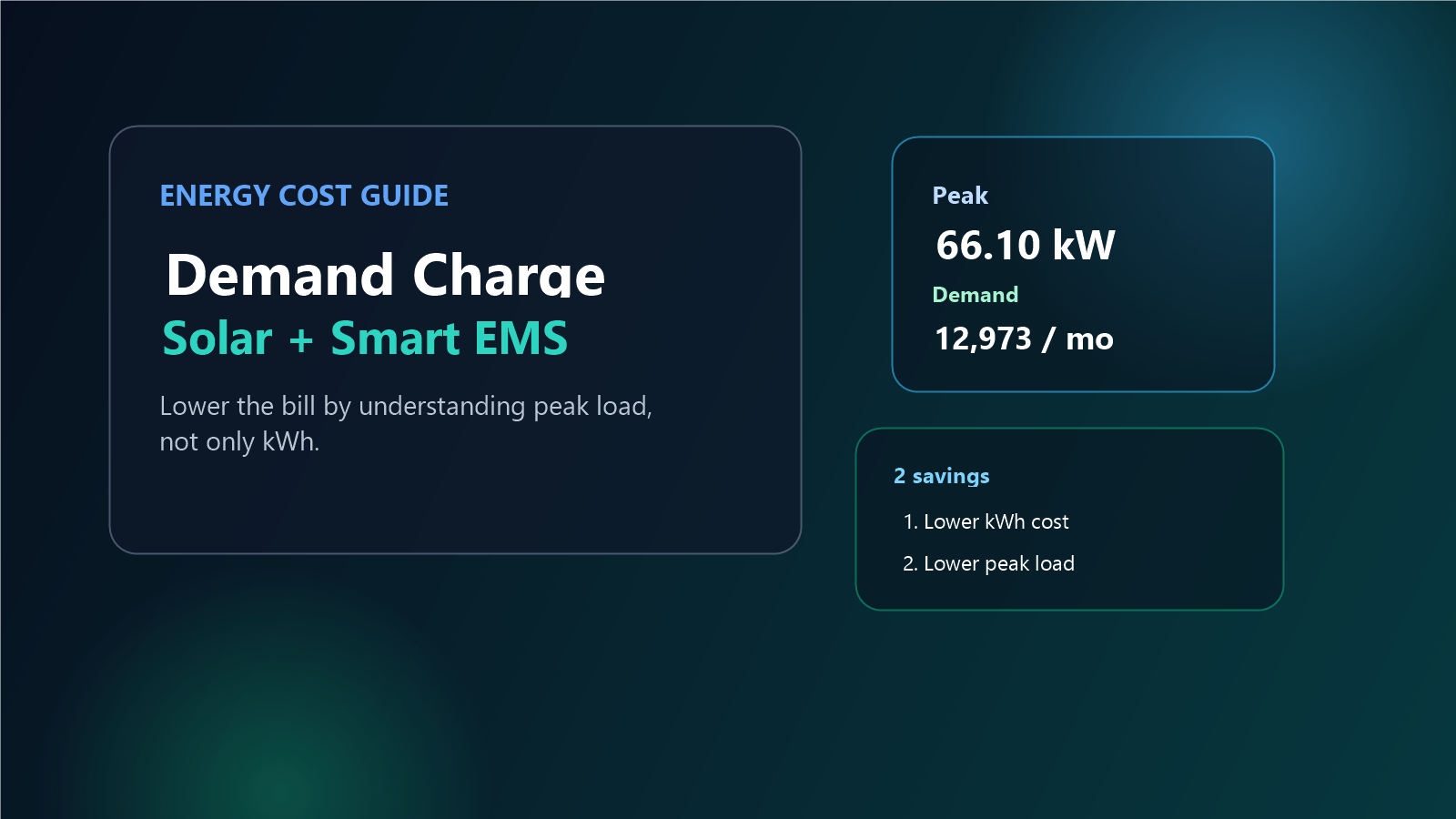
The article focuses on the relationship between peak demand, purchased energy, solar production, and smart load control.
Main takeaway
Solar alone is not always enough
Good energy cost reduction is not only about installing more solar. It also requires understanding when power is used, how much is used at the same time, and how to keep peak load under control.
Full English version
Why business electricity bills can stay high even when energy use does not look excessive
In many commercial sites, the final electricity bill is not driven only by the amount of energy consumed over the month. It is also influenced by the highest level of power used at any one moment. That is why a business can have what seems like moderate monthly consumption and still face a surprisingly high bill.
The problem usually appears when several high-load systems operate at the same time. Air-conditioning, pumps, compressors, machinery, lifts, EV chargers, or service-center equipment may only overlap for a short period, but that short overlap can set the peak demand level used to calculate the demand-related part of the bill.
What Demand Charge really means
Demand Charge is a charge based on maximum power demand, measured in kW, not on energy consumption in kWh. It reflects the fact that the utility infrastructure must be ready to supply that peak level when your site calls for it. In the example bill, peak demand is 66.10 kW and the demand rate is THB 196.26 per kW, leading to a monthly demand charge of approximately THB 12,972.79.
If that peak can be reduced by 10 kW, the site could save around THB 1,962.60 per month, or roughly THB 2,100 including VAT. That saving comes from load management, even before counting any reduction in purchased energy.
How solar helps, and where its limits are
Solar helps in two main ways. First, it reduces the amount of energy purchased from the utility during the hours when solar production is available and on-site consumption exists. Second, it may reduce peak demand if the peak happens during daytime when the solar system is actively producing power.
But it is important not to overstate this. A 30 kWp solar system does not automatically reduce demand by 30 kW. Real results depend on the actual load profile, the time the peak occurs, weather conditions, and how the site operates during the day.
Example: Solar 30 kWp on this type of site
As a preliminary example, a 30 kWp system may generate around 3,400 kWh per month. If most of that energy is self-consumed, it could reduce the monthly electricity bill by about THB 12,000 from the energy portion alone. If, in parallel, the site also reduces peak demand by 10 kW through smarter load coordination, it may save another THB 2,100 per month. That brings the rough combined saving potential to around THB 14,100 per month.
This should still be treated as an early estimate. The actual result depends on the true load profile. If the site has weak daytime consumption or if the worst peak occurs late in the day, the real benefit will differ.
Why financing structure matters too
When projects are financed at around 6%, the choice between a 5-year and a 7-year structure affects cash flow. A 5-year plan usually means lower total financing cost but higher monthly payments. A 7-year plan reduces the monthly burden, which can help in the early period, but increases the total repayment. In practice, the better choice depends on whether the business is optimizing for short-term cash flow flexibility or stronger long-term return.
How Lowell AI Core supports better energy decisions
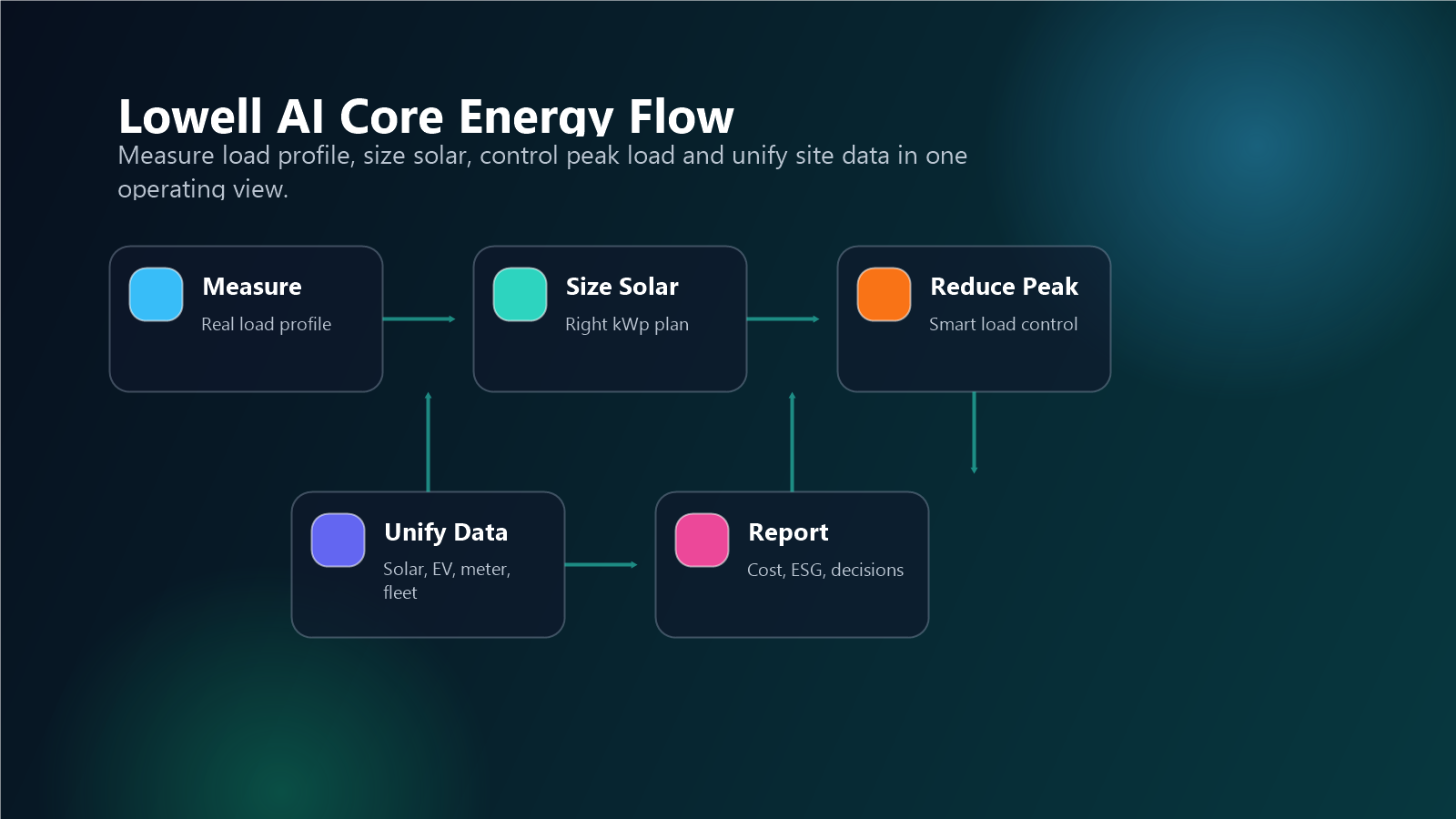
Lowell AI Core is designed for sites that need more than a static dashboard. It helps teams work from real operational data:
- Measure the real load profile and identify exactly when peaks happen.
- Analyze the right solar size based on actual daytime usage.
- Reduce peak demand through smart load management and coordination.
- Unify solar, EV chargers, meters, transformers, and fleet-related energy signals in one view.
- Generate reports that support cost decisions, operational reviews, and ESG reporting.
The business-level conclusion
Reducing electricity cost today is not only about adding solar panels. It is about understanding when power is used, how much demand happens at the same time, and how to keep that peak under control. When solar and smart energy management work together, the investment often becomes more economically meaningful than relying on one approach alone.
Need help with a similar site?
LowellTechs can help evaluate the real energy profile first
If your business is paying tens of thousands of baht or more per month in electricity, reviewing the bill together with the actual load profile before investing in solar or expanding EV charging is often the most valuable first step.